 Abandoned
Overview
The town the sand took back

Singapore was laid out on the dunes near the mouth of the Kalamazoo River in 1836 or 1837. Wikipedia credits Oshea Wilder, a New York land speculator who hoped to build a port to rival Chicago and Milwaukee. At its peak the town had two to four mills, depending on the source, a large boarding house, hotels, stores, a schoolroom and a cemetery. Schooners and steamships carried its lumber to Chicago.
The bank is the part people remember. The Bank of Singapore was a wildcat bank, and by 1838 more than $50,000 of its notes were in circulation without the coin reserve the law required. The notes became worthless when the bank failed; one History Center account dates that to 1842. Two of the notes are shown below. The History Center says the bank building was moved upriver to Saugatuck and still stands at 317 Butler Street.
Lumber kept the town going until the woods ran out. After the great fires of 1871, Singapore's mills cut timber to rebuild Chicago. The clear-cut dunes began to move, and blowing sand began to bury the town. In 1875 the main sawmill was taken apart and shipped to St. Ignace, and the last residents left, most of them for Saugatuck. About ten buildings were moved there; the rest were buried or torn down for lumber and firewood.
Timeline
Forty years of Singapore

- Investors from the East found Singapore on the dunes near the mouth of the Kalamazoo River. Wikipedia names Oshea Wilder, a New York land speculator, and gives 1836; the Saugatuck-Douglas History Center gives 1837.
- The Bank of Singapore is one of two wildcat banks in Allegan County. More than $50,000 of its notes are in circulation, without the coin reserve the law required.
- During a long blizzard, barreled flour from the wrecked ship Milwaukie feeds the town. One History Center account says the bank folded this year and its notes became worthless.
- Wilder leaves. James Carter of New York buys his interest and moves to Singapore.
- Carter sells the town to his brother Artemas and Francis B. Stockbridge. They soon build the schooner Octavia at Singapore to carry lumber to Chicago. Wikipedia calls it the first three-masted schooner on Lake Michigan; the History Center calls it one of Michigan's earliest.
- Stockbridge buys out Artemas Carter.
- After the great fires of that autumn, including Chicago's, logging around Singapore speeds up and strips the trees that held the dunes. The town has several hundred people, by Wikipedia's count.
- The principal sawmill is taken apart and shipped to St. Ignace, and the town is empty. Blowing sand, loose now that the trees are gone, is burying it.
What's left
What you'll see


Nothing of the town is visible. The History Center places it on the north side of the river, downstream from Saugatuck and about 4,000 feet from the Lake Michigan shore, and says blowing sand smothered it. The state historical marker stands in front of Saugatuck's village hall, according to a 2023 article. The old USGS sheets below show the river mouth, the dunes and Saugatuck, but no town. The 1928 sheet already shows the river's straight channel to the lake, with the old Saugatuck lighthouse marked at the former mouth to the south.
- Michigan historical marker at Saugatuck's village hall
- The bank building, moved to Butler Street in Saugatuck
- Dunes over the townsite


Historic maps
Singapore on USGS maps, 1928–1958
Crops from the USGS Historical Topographic Map Collection, centered on the townsite. Each sheet shows what surveyors mapped that year; compare them with today's topo and aerial on this page.

Day trip
Plan a day trip to Singapore from Saugatuck
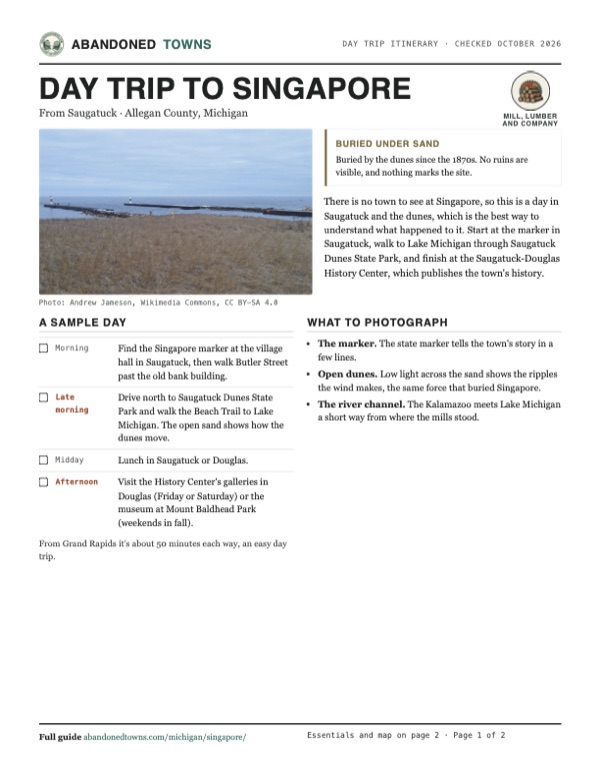
Take it with you
Day trip itinerary
The essentials, the sample day with boxes to tick, what to photograph and the coordinates, on two printable pages. Handy where there's no signal.
Download the PDF (501 KB)There is no town to see at Singapore, so this is a day in Saugatuck and the dunes, which is the best way to understand what happened to it. Start at the marker in Saugatuck, walk to Lake Michigan through Saugatuck Dunes State Park, and finish at the Saugatuck-Douglas History Center, which publishes the town's history.
A sample day
- Find the Singapore marker at the village hall in Saugatuck, then walk Butler Street past the old bank building.
- Drive north to Saugatuck Dunes State Park and walk the Beach Trail to Lake Michigan. The open sand shows how the dunes move.
- Lunch in Saugatuck or Douglas.
- Visit the History Center's galleries in Douglas (Friday or Saturday) or the museum at Mount Baldhead Park (weekends in fall).
From Grand Rapids it's about 50 minutes each way, an easy day trip.
What to photograph and film
- The marker. The state marker tells the town's story in a few lines.
- Open dunes. Low light across the sand shows the ripples the wind makes, the same force that buried Singapore.
- The river channel. The Kalamazoo meets Lake Michigan a short way from where the mills stood.
Map & directions
Getting there
Saugatuck is the nearest town, about 10 minutes south of the map point. From Grand Rapids, take I-196 southwest, about 50 minutes. Both routes end on Saugatuck Beach Road at the map point, where nothing marks the townsite.


Base map: USGS The National Map (public domain). Routes: OSRM on © OpenStreetMap contributors data (ODbL), computed October 2026. Times assume dry roads.
- From Mason Street, turn onto Griffith Street, which becomes Holland Street, and head north.1.1 mi
- Turn left onto 66th Street and follow it as it turns west.1.2 mi
- Bear left onto Point of View Drive to Saugatuck Beach Road, at the map point.0.1 mi
- From downtown, take Fulton Street west and Market Avenue SW to I-196.2.8 mi
- Take I-196 (Gerald R. Ford Freeway) southwest.32 mi
- Leave at exit 41 and turn right onto Blue Star Highway.1.1 mi
- Bear right onto 135th Avenue, then turn right onto 66th Street.0.6 mi
- Continue on 66th Street and bear left onto Point of View Drive.0.5 mi
Road and safety notes
- An undated listing rates the roads 2WD.
- Nothing marks the townsite where the routes end. The marker and the bank building are in Saugatuck.
- The DNR says a Recreation Passport is required for vehicle entry to Saugatuck Dunes State Park.
Photos
Singapore in pictures
Visitor reports
Been to Singapore?
Been there lately? Tell the next visitor what you found: whether you could get in, the state of the road and what's still standing. Photos are welcome. We read every report before it appears here.
Mill, lumber and company
More mill, lumber and company ghost towns
The nearest in Michigan.

 Guide
Pere Cheney
44.58, -84.64Crawford County, Michigan
A lumber and railroad town that diphtheria emptied in the 1890s and that was gone by 1917. Its cemetery, in a clearing in the pines, is all that is…
 Guide
Port Crescent
44.00, -83.06Huron County, Michigan
A sawmill and salt port at the mouth of the Pinnebog River that lost its forests to the fires of 1871 and 1881 and its last business in 1936. The…
Nearby
Other sites near Singapore
Straight-line distance from the townsite to other mapped sites in our Michigan index.
- Mentha31.2 mi SE · Van Buren
- Elmdale47.0 mi E · Ionia
- Bertrand62.5 mi S · Berrien
- Ferry62.7 mi N · Oceana
- Vickeryville72.1 mi NE · Montcalm
- Butternut74.0 mi NE · Montcalm
- Delta Mills79.3 mi E · Eaton
- Marlborough84.0 mi N · Lake
Sources
Sources and credits
- ghosttowns.com, "Singapore": fact sheet fields (roads, climate, best time, remains, population of about 200).
- Wikipedia, "Singapore, Michigan", retrieved October 2026: Wilder and the 1836 founding, banks and the $50,000 in notes, the 1842 blizzard and the Milwaukie, the Carters and Stockbridge, the Octavia, population by 1871, the fires and the burial, abandonment by 1875, coordinates and elevation.
- Saugatuck-Douglas History Center, "Singapore", read October 2026: location north of the river about 4,000 feet from the shore, the 1837 founding, mills and buildings, lumber shipped by schooner and steamship, the Octavia, the wildcat bank and its 1842 failure, the bank building at 317 Butler Street, the sawmill moved to St. Ignace in 1875, and blowing sand smothering the town.
- Saugatuck-Douglas History Center, official site: locations and hours, as of October 2026.
- Great Lakes Echo, "A city lies buried under Michigan's west coast" (January 2014): logging for the Chicago rebuild, 23 buildings, about 100 people, about 10 buildings moved to Saugatuck, the rest buried or scavenged for lumber and firewood.
- Read the Plaque, "Singapore, Michigan": the state marker's text.
- Nathan Reed, "See the fascinating history of Michigan's only buried ghost town", 99.1 WFMK, December 30, 2023: the marker in front of Saugatuck Village Hall, the bank building nearby.
- Michigan DNR, Saugatuck Dunes State Park, read October 2026: address, phone, shoreline, trails, Beach Trail, vault toilets, Recreation Passport, nearby restaurants.
- Coordinates: Wikipedia (from USGS GNIS). Routes: OSRM on OpenStreetMap data, October 2026.
Photo and map credits
- A Bank of Singapore one-dollar note, January 1838: Unknown artist and unknown engraver, Wikimedia Commons, Public domain
- A Bank of Singapore three-dollar note, 1838: Unknown artist and unknown engraver, Wikimedia Commons, Public domain
- Singapore's plat on an 1873 map: Unknown cartographer, Wikimedia Commons, Public domain
- Dune grass and the harbor piers at the mouth of the Kalamazoo River, near the buried townsite, March 2017: Andrew Jameson, Wikimedia Commons, CC BY-SA 4.0
- The Singapore historical marker in front of Saugatuck Village Hall (undated): Gpwitteveen, Wikimedia Commons, CC BY-SA 3.0
- Topo map, area base map and aerial imagery: USGS The National Map (public domain).
- Historic maps: USGS Historical Topographic Map Collection (public domain): Fennville 1928, 1:62,500; Racine 1958, 1:250,000.