 Abandoned

Overview
A lumber camp, a playground for Knoxville, and a park's long argument

Elkmont sits where Jakes Creek runs into Little River, in a narrow, flat-bottomed valley with Meigs Mountain to the west and Sugarland Mountain to the east. Farmers had lived along Jakes Creek since the 1840s, but the town began in 1908, when the Little River Lumber Company made it the base for cutting the upper Little River valley. It was a plain logging camp: shanties that could be loaded onto flatcars, a post office, a commissary, a transient hotel and sheds for the railroad.
As the slopes were stripped, the company sold the valley as a getaway. Sunday trains ran from Knoxville from 1909. In 1910 a club of Knoxville hunters and anglers bought the land south of the creek mouth and built the Appalachian Club, and in 1912 the 50-room Wonderland Hotel opened on the hill above. Cottages filled Daisy Town, Society Hill and Millionaires' Row. Elkmont cottage owners Willis and Anne Davis and David Chapman were among the first to push for a national park in the Smokies.
When the park came, the cottage owners kept their places on leases, and those ran until 1992. Then the buildings passed to the Park Service, which first planned to remove them all. A long fight followed. In 2009 the park chose to save the clubhouse and 18 cabins and outbuildings and take down the rest. The last of the 19 was finished in 2024. The logging town itself lies under the campground, built in the 1960s.
Video
Elkmont in 30 seconds
A 1908 logging town turned summer colony: the Appalachian Clubhouse, the Wonderland Hotel on an old postcard, its site today, and the Levi Trentham cabin.
Timeline
From Little River to Daisy Town

- The Levi Trentham cabin is built on upper Jakes Creek. It is the oldest building left at Elkmont and was moved down to Daisy Town in 1932.
- Jacob Hauser and then David Ownby's family settle on Jakes Creek. The farming community is known simply as Little River.
- Knoxville businessman John L. English logs Jakes Creek and floats the logs down Little River with splash dams. His venture has folded by 1900.
- Colonel Wilson B. Townsend forms the Little River Lumber Company and buys 86,000 acres along Little River.
- The company founds Elkmont as the base for its logging in the upper Little River and Jakes Creek valleys.
- The Little River Railroad starts the Sunday "Elkmont Special" from Knoxville.
- Knoxville hunters and anglers form the Appalachian Club and buy the land that becomes Daisy Town.
- Charles Carter opens the 50-room Wonderland Hotel on a hill above the valley. A group of Knoxvillians buys it in 1919 and forms the Wonderland Club.
- Logging above Elkmont ends and the tracks are pulled up and moved to Tremont. A road from Townsend follows the old grade in 1926, the year Townsend sells most of his tract to the park commission.
- As the national park is created, most cottage owners sell at half price in exchange for lifetime leases.
- The Appalachian Club builds a new clubhouse to replace the first, which burned in 1932.
- The Little River Lumber Company stops work after cutting 750 million board feet of lumber.
- The leases become 20-year leases in 1952 and are renewed in 1972. In 1992 the park does not renew them.
- The park builds today's campground over the site of the logging town.
- The hotel and dozens of cottages are listed on the National Register as the Elkmont Historic District.
- The Wonderland Hotel collapses. Its annex burns in May 2016.
- The park decides to restore the Appalachian Clubhouse and 18 cabins and outbuildings, and to document and remove the rest.
- Wikipedia dates the removal of the remaining buildings to 2018; many chimneys are left standing.
- The Chapman-Byers cabin, the last on the list, is finished, and the park says its restoration commitment is met.
1992–2024
Saving 19 buildings

The park's 1982 management plan called for every structure to go so the forest could take the valley back. The 1994 National Register listing changed that, and the argument ran for 15 years. The 2009 decision kept the oldest and most significant group, almost all in Daisy Town: the Appalachian Clubhouse of 1934, the Levi Trentham log cabin, the Addicks and Mayo cabins, which are thought to be reworked lumber company shanties, and a children's playhouse called Adamless Eden. The Byers cabin on Society Hill was kept for its link to David Chapman, and the Spence Cabin on Millionaires' Row for its spot at the head of the Little River Trail.
Everything in the Wonderland Club section was to be removed. Wikipedia says the main hotel collapsed in 2005 and its annex burned in May 2016; WUOT's 2024 report says instead that a 2016 fire burned the hotel to the ground, leaving only its steps. How many buildings came down is not settled: WUOT's 2024 report gives both roughly 60 slated for demolition and about 80 demolished. The Appalachian Clubhouse and the Spence Cabin were rehabilitated in 2010 and are rented for day use.
What's left
Cabins, chimneys and a campground


Most of the restored buildings stand in Daisy Town, along the road up Jakes Creek. The Park Service says visitors can explore the cabins inside and out (October 2025), and WUOT reported in September 2024 that the clubhouse is open inside only to paid group reservations. The Park Service points hikers up the Jakes Creek and Little River trails, past the stone walls and chimneys of the cottages that were removed. Little of the logging town survives beyond the Addicks and Mayo cabins, which may be reworked company shanties; the campground covers its site.
The 1886 sheet in the historic maps below shows Jakes Creek and Blanket Mountain with no town at all. By 1943 the Gatlinburg sheet marks Elkmont with a row of buildings along Jakes Creek, and Camp LeConte to the northwest. The 1956 sheet adds the Elkmont Ranger Station and a cemetery beside the Jakes Creek road, and the 1979 sheet shows the campground loops, an amphitheater and a nature trail.
- Appalachian Clubhouse (1934)
- Levi Trentham cabin (c. 1830)
- Addicks and Mayo cabins
- Chapman-Byers cabin
- Spence Cabin
- Adamless Eden playhouse
- Chimneys and stone walls
- Wonderland Hotel site
- Cemetery


Historic maps
Elkmont on USGS maps, 1886–1979
Crops from the USGS Historical Topographic Map Collection, centered on the townsite. Each sheet shows what surveyors mapped that year; compare them with today's topo and aerial on this page.

Day trip
Plan a day trip to Elkmont from Gatlinburg
Take it with you
Day trip itinerary
The essentials, the sample day with boxes to tick, what to photograph and the coordinates, on two printable pages. Handy where there's no signal.
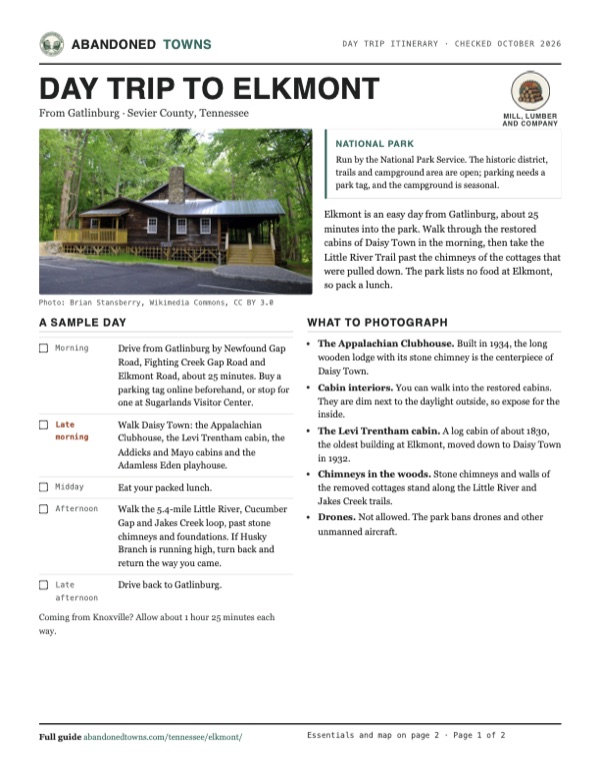
Download the PDF (651 KB)Elkmont is an easy day from Gatlinburg, about 25 minutes into the park. Walk through the restored cabins of Daisy Town in the morning, then take the Little River Trail past the chimneys of the cottages that were pulled down. The park lists no food at Elkmont, so pack a lunch.
A sample day
- Drive from Gatlinburg by Newfound Gap Road, Fighting Creek Gap Road and Elkmont Road, about 25 minutes. Buy a parking tag online beforehand, or stop for one at Sugarlands Visitor Center.
- Walk Daisy Town: the Appalachian Clubhouse, the Levi Trentham cabin, the Addicks and Mayo cabins and the Adamless Eden playhouse.
- Eat your packed lunch.
- Walk the 5.4-mile Little River, Cucumber Gap and Jakes Creek loop, past stone chimneys and foundations. If Husky Branch is running high, turn back and return the way you came.
- Drive back to Gatlinburg.
Coming from Knoxville? Allow about 1 hour 25 minutes each way.
What to photograph and film
- The Appalachian Clubhouse. Built in 1934, the long wooden lodge with its stone chimney is the centerpiece of Daisy Town.
- Cabin interiors. You can walk into the restored cabins. They are dim next to the daylight outside, so expose for the inside.
- The Levi Trentham cabin. A log cabin of about 1830, the oldest building at Elkmont, moved down to Daisy Town in 1932.
- Chimneys in the woods. Stone chimneys and walls of the removed cottages stand along the Little River and Jakes Creek trails.
- Drones. Not allowed. The park bans drones and other unmanned aircraft.
Map & directions
Getting there
Gatlinburg is the closest town, about 25 minutes away by Newfound Gap Road and Fighting Creek Gap Road. From Knoxville the route runs out I-40, south on SR 66 and the Parkway, and around Gatlinburg on the bypass. Both routes end inside the campground, on the site of the logging town; the cabins are along the road up Jakes Creek just south of it.


Base map: USGS The National Map (public domain). Routes: OSRM on © OpenStreetMap contributors data (ODbL), computed October 2026. Times assume dry roads.
- From downtown Gatlinburg, follow East Parkway (US 321).1.1 mi
- Continue on Newfound Gap Road (US 441) into the park.1.7 mi
- Turn right onto Fighting Creek Gap Road.4.9 mi
- Turn left onto Elkmont Road and follow the campground roads to the site.1.9 mi
- From Henley Street (US 441), take the ramps to I-40 east.0.9 mi
- Follow I-40 east.19.2 mi
- Take the exit for SR 66 and follow Winfield Dunn Parkway (SR 66).8.7 mi
- Continue on Forks of the River Parkway (US 441), then turn right onto the Parkway.7.7 mi
- Continue on the Gatlinburg Spur Road (US 321/US 441).4.3 mi
- Bear right onto the Gatlinburg Bypass Road, which joins Newfound Gap Road.4.3 mi
- Turn right onto Fighting Creek Gap Road.4.9 mi
- Turn left onto Elkmont Road and follow the campground roads to the site.1.9 mi
Road and safety notes
- Parking anywhere in the park for more than 15 minutes needs a physical parking tag: $5 a day, $15 a week, $40 a year. Buy one at a visitor center, a tag machine or online; America the Beautiful passes don't replace it, and it isn't needed on the park's free entrance days (NPS fees page, updated October 8, 2026).
- The park lists Little River Road as open year-round, weather permitting (NPS seasonal roads page, updated April 20, 2026).
- During the synchronous firefly viewing period (May 20 to 27 in 2026), Elkmont was closed after noon to everyone but lottery reservation holders and registered campers, and overnight parking at the Little River and Jakes Creek trailheads and the clubhouse was banned (WVLT, April 21, 2026). Dates change every year.
- The campground is seasonal and needs an advance reservation (NPS, August 2026).
- Laurel Falls Trail, whose trailhead is on Fighting Creek Gap Road, is closed for rehabilitation, with reopening expected in 2027 (NPS closures page, October 15, 2026).
- The routes are computed from OpenStreetMap and haven't been driven by us. We have no dated source on road surfaces.
Photos
Elkmont in photos
Visitor reports
Been to Elkmont?
Been there lately? Tell the next visitor what you found: whether you could get in, the state of the road and what's still standing. Photos are welcome. We read every report before it appears here.
Mill, lumber and company
More mill, lumber and company ghost towns
The nearest in Tennessee.

 Guide
Tremont
35.62, -83.67Blount County, Tennessee
The Little River Lumber Company's last town, built in 1926 where two mountain streams meet and abandoned when the cutting stopped in 1938. The…
 Guide
Pressmen's Home
36.45, -83.05Hawkins County, Tennessee
For 56 years a printing union ran its headquarters, trade school, sanatorium and hotel from a hidden valley north of Rogersville. The union left in…
Nearby
Other sites near Elkmont
Straight-line distance from the townsite to other mapped sites in our Tennessee index.
- Tremont5.4 mi SW · Blount
- Calderwood25.1 mi SW · Monroe
- Wasp39.1 mi E · Cocke
- Tellico Plains44.9 mi SW · Monroe
- Wheat48.3 mi NW · Roane
- Fork Mountain57.0 mi NW · Anderson
- Pressmen's Home62.4 mi NE · Hawkins
- Montgomery65.8 mi NW · Morgan
Sources
Sources and credits
- ghosttowns.com, "Elkmont": fact sheet fields (climate, best time, remains).
- Wikipedia, "Elkmont, Tennessee", retrieved October 2026: coordinates, geography, the pioneer settlers, the logging town and its buildings, the Little River Lumber Company, the Appalachian and Wonderland clubs, the leases, the National Register listing, the hotel's collapse and the annex fire, the 2009 plan and the buildings it kept, the 2018 removals.
- National Park Service, "Metcalf Bottoms & Elkmont Area", updated October 30, 2025: Daisy Town, the 18 preserved cabins, the 2010 rehabilitation of the clubhouse and Spence Cabin for day use by reservation, the Jakes Creek and Little River trails.
- National Park Service, "Fees & Passes", updated October 8, 2026: parking tag rules and prices, where to buy tags, the physical-tag rule, no entrance fee, and the 2026 fee-free days.
- National Park Service, "Seasonal Road Schedule", updated April 20, 2026: Little River Road open year-round, weather permitting.
- National Park Service, "Frontcountry Camping", updated August 12, 2026: campgrounds other than Cades Cove and Smokemont are seasonal; reservations required.
- National Park Service, temporary closures, updated October 15, 2026: the Laurel Falls Trail closure.
- WUOT, "National Park Service completes restoration of historic Elkmont homes and cabins", September 2, 2024: the Chapman-Byers cabin, 19 restored structures, walk-through access, the clubhouse's reservation-only interior, the 2016 fire and the demolition figures.
- National Park Service, "Daisy Town", updated October 10, 2025: visitors can explore the cabins inside and out; the clubhouse is reserved for events through recreation.gov; amenities listed as exhibits, parking and seasonal restrooms.
- National Park Service, "Hike Little River Trail", updated December 17, 2025: 12.4 miles round trip, the chimneys and foundations, the rockier going past Rough Creek, not ADA accessible, GRIT Freedom Chairs for the first 2.7 miles, no pets.
- National Park Service, "Hike the Little River, Cucumber Gap, Jakes Creek Loop", updated October 10, 2025: 5.4 miles round trip and the high-water warning at Husky Branch.
- National Park Service, "Laws & Policies", updated June 28, 2024: the drone ban and the rule on pets on trails.
- WVLT, "Want to See the Synchronous Fireflies? Elkmont Lottery Opens Friday", April 21, 2026: the 2026 viewing dates, lottery, reservations and access limits.
- Photos: Wikimedia Commons, credited below each one. Elevation: USGS 3D Elevation Program point query. Routes: OSRM on OpenStreetMap data, October 2026. Not field-checked.
Photo and map credits
- The Appalachian Clubhouse, built in 1934, May 2011: Brian Stansberry, Wikimedia Commons, CC BY 3.0
- The logging town in 1915: Unnamed photographer, Wikimedia Commons, Public domain
- A Little River Lumber Company steam skidder, 1913: United States Forest Service, Wikimedia Commons, Public domain
- The Wonderland Club Hotel on a postcard, about 1930 to 1945: Pub. by Graphic Arts Agency, Knoxville, Tenn., Wikimedia Commons, Public domain
- The Wonderland Hotel site, July 2007: Brian Stansberry, Wikimedia Commons, CC BY 2.5
- Spindletop, a cottage on Millionaires' Row, October 2007: Brian Stansberry (photographer), Charlotte Appleton (description), Wikimedia Commons, CC BY 3.0
- Inside the Appalachian Clubhouse before its rehabilitation, December 2005: Steven C. Price, Wikimedia Commons, CC BY-SA 3.0
- The Sneed cabin, December 2005: Steven C. Price, Wikimedia Commons, CC BY-SA 3.0
- The Levi Trentham log cabin, center, April 2004: Steven C. Price, Wikimedia Commons, CC BY-SA 3.0
- Area base map, topo and aerial imagery: USGS The National Map (public domain).
- Historic maps: USGS Historical Topographic Map Collection (public domain): Knoxville 1886, 1:125,000; Gatlinburg 1943, 1:24,000; Gatlinburg 1956, 1:24,000; Gatlinburg 1979, 1:24,000.